Do you love the idea of solar but worry your San Lorenzo Valley redwoods will block the sun? You are not alone. In SLV, canopy, fog, and roof details matter as much as panels and price. In this guide, you will learn how shade and orientation affect output, what PG&E will require, and how to plan permits, batteries, and timelines with confidence. Let’s dive in.
San Lorenzo Valley solar reality
Coastal Santa Cruz County has a solid solar resource, even if direct sun is lower than inland areas. Marine influence brings more diffuse light, which solar panels can use, but peak sun hours are lower than the Central Valley. Production is still strong enough for many homes when the array is well placed.
SLV’s terrain creates microclimates. Valley floors can hold fog and see more morning or winter shading. Ridges often clear earlier and get longer sun windows. Two properties a quarter mile apart can produce very different annual output.
Installers model your site rather than rely on county averages. Expect a shade report and a PV model using tools such as NREL’s PVWatts or NSRDB. The right study converts your roof’s tilt, azimuth, and shade pattern into an annual kWh estimate so you can compare bids apples to apples.
Microclimates and terrain
Fog and low winter sun angles matter in SLV. Tall redwoods cast long shadows in winter, which can reduce annual yield more than summer shade. Homes tucked near valley walls may lose early or late sun. If you split your array across roof planes that see different sun windows, you can recover some output.
Why modeling matters
A 10 percent shade loss at noon is not the same as a 10 percent loss at 4 p.m. during peak rates. Modeling shows when shade hits, how it affects strings or modules, and how much energy you can self-consume under your time-of-use plan. Ask for hourly or monthly production charts and the assumed shading percentages.
Shade from redwoods
Redwood canopy is dense and tall. Shade shifts across the day and seasons, and winter shadows are long. Even small patches of shade can hurt a traditional string system if one shaded module drags down the circuit.
How shade cuts output
Partial shade can reduce output more than it appears from the ground. The impact depends on how many modules are shaded, when shade occurs, and how your array is wired. Losses can range from a few percent for intermittent shade to much larger reductions when shade is frequent or prolonged. A site-specific shade analysis is the only reliable way to quantify it.
Smart mitigation options
- Use module-level power electronics, such as microinverters or DC optimizers, to limit string-level penalties from partial shade.
- Place panels on multiple roof planes to reduce the hours when the entire system is shaded.
- Consider a ground or pole mount in a cleared area if the roof is too shaded.
- Work with a certified arborist for selective pruning where allowed. Do not assume trimming or removal is permitted without review.
- Pair with a battery to shift self-consumption into peak time-of-use periods. A battery does not create energy, but it can increase the value of what you produce.
Orientation and tilt basics
In the northern hemisphere, true south-facing arrays typically maximize annual kWh. West-facing can perform nearly as well and often aligns better with late afternoon usage. East-facing can still make sense with the right load profile.
Tilt affects seasonal balance, but typical roof pitches are acceptable. In Santa Cruz County, the difference between an optimal tilt and a standard roof pitch is usually modest compared to the impact of shade. Ask your installer to model south, west, and mixed planes under your time-of-use plan so you can see energy value, not just total kWh.
Roof type and structure
Composition or asphalt shingle is common and straightforward with standard flashing and mounts.
Clay or concrete tile requires specialized hardware and careful handling. Some tiles may need replacement.
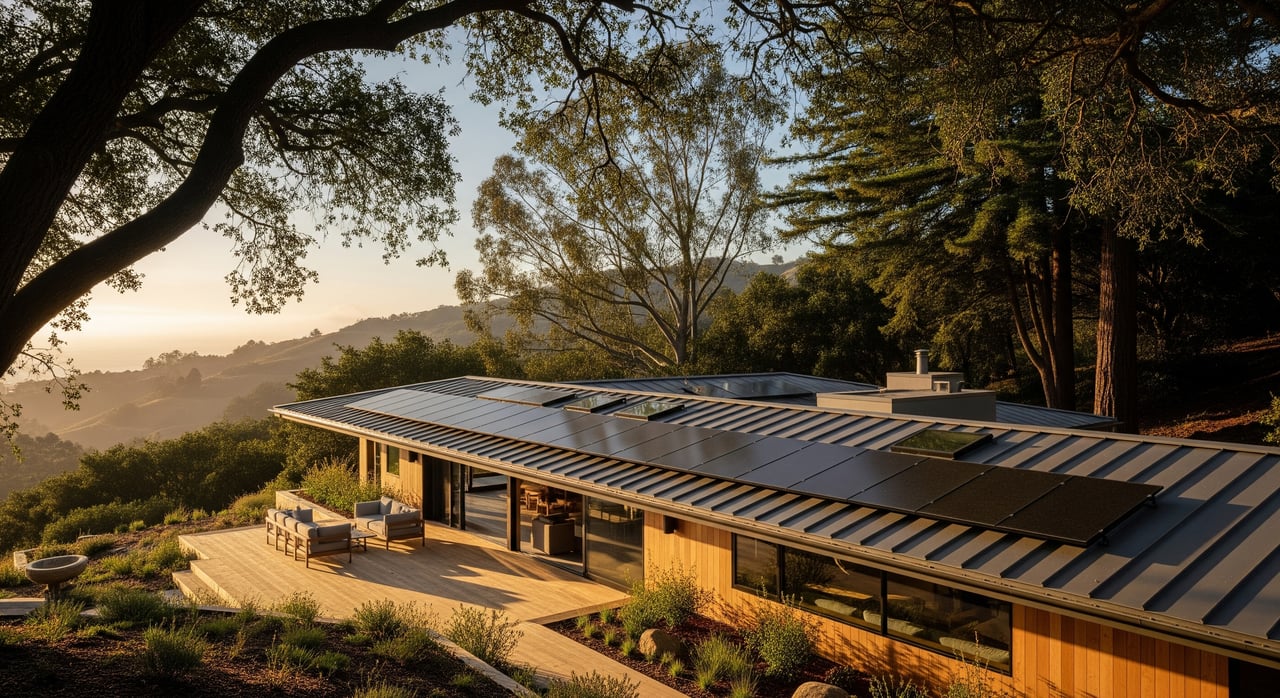
Metal standing seam is often ideal since clamps avoid many penetrations.
Flat roofs use racking or ballasted systems. Verify roof condition and drainage.
If your roof has less than 5 to 10 years of life, plan to replace it before installing solar or budget for panel removal and reinstallation later. Solar adds dead load and wind load. Most homes can support it with standard racking, but steep, complex, or older structures might need a structural review.
California’s Solar Rights Act limits unreasonable HOA restrictions on solar. Still, check any design guidelines or approvals needed before you proceed.
PG&E interconnection steps
Most installers manage the process, but it helps to know the sequence:
- Pre-install assessment and design. The installer completes a shade study, roof review, and system layout.
- Interconnection application. Forms, equipment specs, and a one-line diagram are submitted to PG&E.
- Installation and inspections. Local building and electrical inspections occur, and PG&E schedules meter work as needed.
- Permission to Operate. PG&E issues final approval once safety checks are complete. This is often called PTO.
Timelines vary from a few weeks to several months, depending on permits, inspection queues, and whether upgrades are needed. Systems with batteries or backup capability require additional safety review for anti-islanding and transfer equipment.
Net metering and TOU value
California’s net energy metering rules have shifted to emphasize the time value of exports. Under current structures, the price you receive for exported energy depends on when you send it to the grid. This change makes system design and battery pairing more sensitive to your daily usage.
Time-of-use periods often give higher value to late afternoon and early evening. A west-facing array or a battery that shifts energy into those hours can improve the economics. Incentives such as the federal Investment Tax Credit and California’s Self-Generation Incentive Program for batteries can be material, but availability and eligibility change over time. Ask your installer to model multiple scenarios under current PG&E rates and CPUC rules.
Resilience with batteries
Public Safety Power Shutoffs have affected Santa Cruz County during high fire risk events. If you need backup for critical loads, a battery can keep lights on when the grid is down and can store solar energy for peak time-of-use periods.
Backup-capable systems must isolate from the grid during outages, meet National Electrical Code requirements, and pass PG&E safety review. Expect an added layer of permits, inspections, and equipment for islanding and load control. Discuss which circuits you want backed up and how long you want them to run under typical outage conditions.
Permits and local rules
Rooftop PV requires building and electrical permits from the local authority. For unincorporated SLV addresses, that is the Santa Cruz County Building Division. Permit packets typically include plans, equipment specs, and structural details if required.
Tree work is regulated. Redwoods are protected, and properties near riparian corridors or sensitive habitats have additional constraints. Consult the County Planning Department and a certified arborist before any trimming or removal. Unpermitted work can lead to fines and neighbor conflicts.
For fire safety, follow defensible space guidelines and any local fire authority requirements. Battery installations have specific spacing, ventilation, and emergency access standards that the fire department will review.
Who to consult first
- A solar installer with SLV shading experience. Ask for a full production model with module-level outputs and shade assumptions.
- An ISA-certified arborist to assess canopy, health, and legal requirements for trimming or removal.
- A structural engineer if your home is older, has unusual framing, or faces higher wind exposure.
- A licensed electrician, often through your solar contractor, to ensure National Electrical Code and PG&E requirements are met.
- County building, planning, and local fire officials to confirm permits early.
- Your real estate agent or escrow officer if you are buying, to clarify solar ownership, production history, and any tree or permit obligations.
Set realistic expectations
- Site specifics drive results. Two neighbors can see very different production because of redwood shade and terrain.
- Shade often reduces output more than casual inspection suggests. Insist on a formal shade report and a modeled PV estimate.
- If major tree work is needed, plan for permits, arborist reports, and possible limits. A smaller array plus a battery may be a better fit for some properties.
- Budget for roof work if replacement is likely within 5 to 10 years, including potential removal and reinstallation costs.
- Interconnection and permitting add weeks to months. Batteries add more steps and time.
- Microinverters or optimizers add cost but often deliver better real-world results on shaded SLV roofs.
Buyer tips for SLV homes
If you are shopping in the valley, solar potential can be a tie-breaker:
- Request a solar shade report and PV model for the address. If a system exists, ask for the last 12 months of production data.
- Clarify whether the system is owned or leased and how transfer works.
- Ask for roof age, condition, and any recent repair paperwork.
- Check for tree ordinances, past permits, and any open notices related to tree work or PV.
- If you plan to add a battery, confirm panel capacity and space for backup equipment.
Quick checklist
- Get shade analyses and production models from at least two reputable installers.
- Run a PVWatts or NSRDB estimate for the address as a baseline.
- Consult a certified arborist before any trimming or removal. Verify county permit rules.
- Check roof age and plan for replacement if it is near end of life.
- Review PG&E interconnection steps, your time-of-use plan, and current net metering rules with your installer.
- Ask about battery pairing for resilience and export value, including incentives and eligibility.
- Confirm permit timelines with the Santa Cruz County Building Division and local fire authority.
- For buyers, collect production data, system ownership details, and any related disclosures in escrow.
Planning solar in SLV is about matching the site to the right design, then lining up permits and interconnection. With a clear shade study, smart equipment choices, and realistic timing, you can achieve meaningful bill savings and better resilience under local conditions. If you want a local perspective as you evaluate a property or prep for upgrades, our team at The Portola Group is here to help.
FAQs
Is solar viable with redwood shade in SLV?
- Yes, but it is site-specific. A formal shade analysis, module-level electronics, and smart array placement are key to reliable production.
What roof orientation works best near Santa Cruz?
- South-facing usually maximizes kWh, while west-facing can align better with late afternoon time-of-use value. Ask your installer to model both.
How long does PG&E interconnection take?
- Expect a few weeks to several months depending on permits, inspections, and whether upgrades or batteries are involved.
Do I need a permit to trim or remove redwoods for solar?
- Often yes. Check with the Santa Cruz County Planning Department and hire a certified arborist to assess rules, health, and options.
Should I add a battery under current California net metering?
- Many homes benefit due to time-based export pricing and resilience needs, but the value depends on your usage, rates, and budget.
What roof types are easiest for solar installation?
- Metal standing seam is often simplest, composition shingle is straightforward, and tile requires specialized hardware and care.
As a buyer, how can I evaluate a home’s solar potential?
- Request a shade report or PV model, review any existing production data, verify system ownership, and check roof age and tree rules.