If you are thinking about buying a home in San Lorenzo Valley, utilities may look a little different than what you are used to in town. Many properties rely on septic systems, private wells, propane, and backup power planning instead of city sewer and water. The good news is that once you understand the basics, you can ask smarter questions, avoid surprises, and feel more confident about the property you choose. Let’s dive in.
Why utilities work differently here
San Lorenzo Valley has a rural infrastructure pattern shaped by terrain, older development, and water-quality protections. In the Santa Cruz County portion of the San Lorenzo River Watershed, the county says there are about 15,200 onsite wastewater treatment systems out of 27,700 countywide, and about 85% of watershed development predates current septic standards.
That matters because many parcels cannot meet today’s standards due to small lot size, proximity to streams, high groundwater, steep slopes, or clay soils. The county also notes that earlier efforts to expand sewer service largely failed because of cost and environmental impact. In practical terms, you should expect more owner-maintained systems here than in a typical city neighborhood.
The county also says rural properties often do not receive municipal sewer or water service, and more than 21,000 county residents rely on private wells that are not routinely monitored. So when you buy in the valley, part of your due diligence is learning how the property handles wastewater, water supply, and power.
Septic basics in San Lorenzo Valley
In much of San Lorenzo Valley, septic is the standard solution where sewer service is unavailable or too expensive. A typical conventional system includes a septic tank, usually 1,500 to 2,000 gallons, plus a leachfield. The tank handles primary treatment, and the soil provides final treatment.
Some properties have site constraints that make a standard system difficult. In those cases, county and regional rules may allow alternative systems or special operating conditions. That can be workable, but it usually means more oversight and more careful maintenance.
What happens at resale
Santa Cruz County requires sellers of rural real estate to complete a septic tank inspection report and a disclosure form before closing. If the system is failing, repairs generally must be completed by the seller before the sale closes.
There is one important exception. Repair responsibility can be transferred to the buyer within 90 days after closing if both sides agree. That is something you will want to understand clearly before you remove contingencies.
What a pump report does and does not tell you
County guidance says the pumping report must be completed within 12 months of close of escrow and must include a 250-gallon flow test. That gives you a current snapshot, but it is not a guarantee of long-term performance.
The county specifically cautions that a pumping report only reflects conditions at the time of the pump-out. It may not reveal past issues, future failure, or whether the system meets current code. If you want deeper due diligence, the county offers an optional point-of-sale OWTS evaluation program.
Conventional, nonstandard, and enhanced systems
Not all septic systems are the same. Knowing which type a property has can affect future cost, maintenance, and how easy it is to make changes to the home.
Here is a simple way to think about the main categories:
| System type | What it means for you |
|---|---|
| Conventional | Standard septic tank and leachfield setup, if site conditions allow |
| Nonstandard | Used when a site cannot meet conventional standards, often with added operating conditions |
| Enhanced | More advanced treatment system with stricter service requirements |
If a property has a nonstandard system, county staff inspect it at least annually, charge an annual fee on the tax bill, and record deed notices describing the operating conditions. If it has an enhanced treatment system, a new owner must enter into a service agreement with an approved Onsite System Service Provider at the time of sale.
Septic costs and future upgrades
Septic costs can be significant, especially on difficult sites. The county says enhanced systems for new development can cost at least $50,000, and full replacements can potentially reach $100,000.
That is why buyers should also think beyond the current house. In Santa Cruz County, adding bedrooms, habitable space, or an ADU can trigger septic upgrade standards. If you are buying with future expansion in mind, this is a key issue to investigate early.
Septic maintenance tips
County guidance recommends pumping every 5 to 10 years depending on occupancy, water use, garbage disposal use, and lifestyle. It also warns owners not to drive over, build over, or dig into the leachfield.
Those may sound like small details, but they matter. Good maintenance can help protect both performance and replacement cost over time.
Well water and individual water systems
If a home is served by a private well in Santa Cruz County, that well may be treated as an Individual Water System if it serves 1 to 4 primary dwellings. The county requires permits to construct, reconstruct, or destroy a well, and time-of-sale rules now require testing before transfer.
Since September 1, 2025, sellers of properties served by an Individual Water System must complete both yield and water-quality testing before a transfer is finalized. The county says this applies whether the source is a traditional well, spring, horizontal well, or stream diversion.
What sellers must provide
The seller is responsible for completing the disclosure form and providing the test results to both the buyer and the county. If testing was completed to county code and the results are less than 3 years old, the county may accept them.
This is helpful, but timing still matters. The county advises buyers and sellers to plan early because scheduling, lab turnaround, and reporting can take 3 to 5 weeks.
What well testing usually costs
County guidance says yield testing typically costs about $600 to $1,000 for a 3-hour flow test. If extended testing is needed, there may be an additional hourly charge of about $165 to $185.
For water quality, the county’s example puts total testing around $650 to $900, depending on contractor markup. More advanced or comprehensive testing can range from $1,000 to $10,000.
What water-quality testing includes
The county requires bacteria testing and selected Title 22 inorganic contaminants. It also calls for extra testing in certain areas or when known water-quality risks are present.
That means two valley properties can have different testing requirements depending on location and local conditions. If a result comes back with concerns, it is worth understanding what the county requires next and what treatment options may exist.
Free testing and dry-well help
Santa Cruz County expanded its free well-testing program in 2026 and says that no-cost testing can satisfy household well testing requirements for property sales. The county also notes that households with contaminated wells may qualify for extra help, such as bottled water or small treatment systems.
If a household well goes dry due to drought, the county says it can provide 3,800 gallons of hauled water per household every 6 weeks at no cost while a longer-term solution is pursued. For buyers in a rural area, it is reassuring to know these county support programs exist.
Why well records matter
The county and the California Department of Water Resources maintain well completion reports for many wells. These reports can show total depth, screening intervals, and the depth where water was first encountered.
That record can be valuable background when you are trying to understand how the well was built and what its likely capacity may be. It is not a substitute for current testing, but it can help you ask better questions.
Power, propane, and outage planning
In mountain areas, utility planning is not only about convenience. It is also about resilience. PG&E says Public Safety Power Shutoffs are planned safety outages used when severe weather could damage equipment and create wildfire risk, and Santa Cruz County says wildfire risk is greatest in mountainous areas of north and central Santa Cruz County.
If the home’s water comes from a pump, PG&E says you will likely not be able to access water during an electric outage. That is one reason backup planning matters so much for valley buyers.
Questions to ask about backup power
A good utility conversation should include more than just the electric bill. Ask how the property performs when the power goes out and whether critical systems can keep running.
Focus on questions like these:
- Does the well or water system depend on electric pumping?
- Is there battery backup on site?
- Is there solar, and if so, is it configured to help during outages?
- Is there a generator, and was it installed safely?
County guidance for off-grid solar notes that remote rural properties may need flexible and cost-effective power sources where commercial power is unavailable or expensive to extend. It describes battery storage plus generator backup as part of a stand-alone system.
PG&E also warns that standby or portable generators should not be connected to a service panel unless installed by a licensed electrician. Improper connection can backfeed the grid and create danger for utility workers and people in the home.
Propane is part of the picture
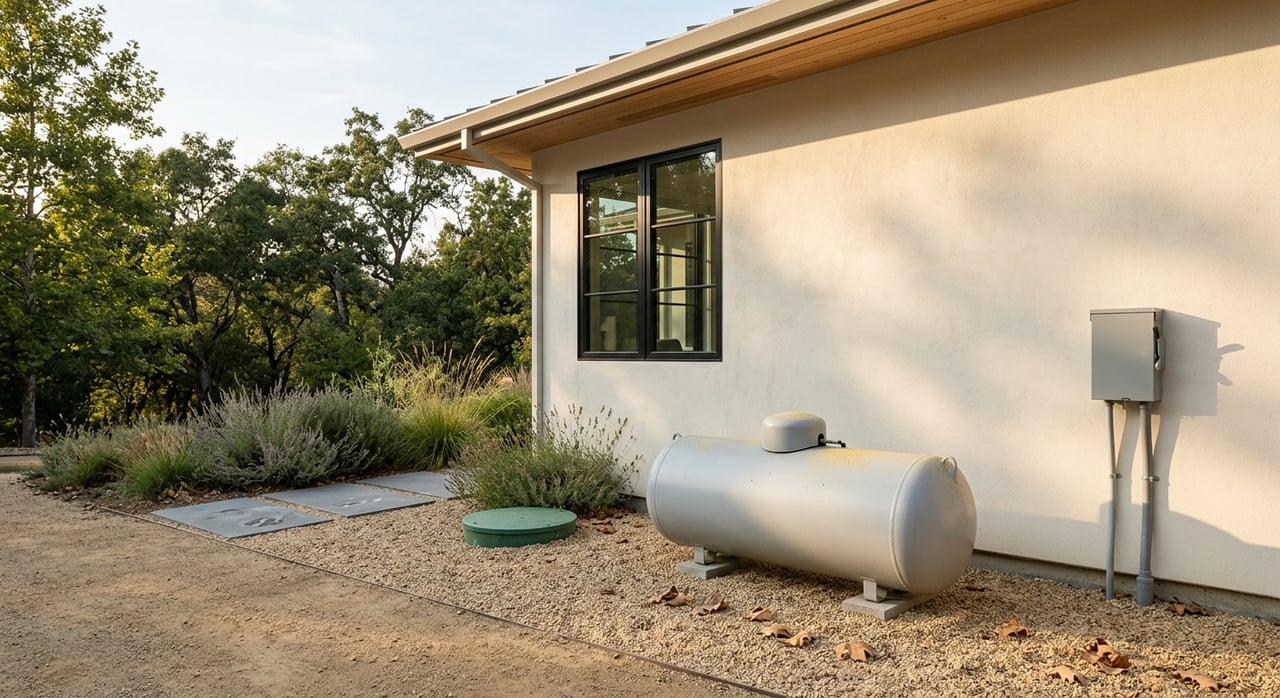
Propane is common in rural residential development in Santa Cruz County. It may be used for heating, cooking, water heating, or backup systems depending on the property.
County planning materials also note that setback rules specifically address propane tanks, and in some cases they may be allowed as close as 5 feet to a property line. When you evaluate a property, it is smart to ask where propane is used and where the tank is located.
Your valley utility due-diligence checklist
If you are considering a home in San Lorenzo Valley, these are some of the most useful questions to ask before you close:
- Request the county septic file, point-of-sale septic inspection, and any repair permits.
- Confirm whether the septic system is conventional, nonstandard, or enhanced.
- Ask whether there is an annual service agreement or annual tax-bill fee tied to the septic system.
- Check when the septic tank was last pumped and whether the report is within the county’s 12-month window.
- Ask for the required 250-gallon flow test results.
- Request the well completion report, last yield test, and last water-quality test.
- Confirm whether the well test results are current under county rules.
- Ask how the home functions during power outages, especially if water depends on a pump.
- Ask whether there is battery backup, solar, or a properly installed generator.
- Find out where propane is used and where the tank is located.
- If you hope to remodel, add a bedroom, or build an ADU, ask whether that could trigger septic upgrade standards.
These questions can save you time, money, and stress. They also help you compare properties more accurately, since two homes at a similar price point can have very different infrastructure obligations.
Why local guidance matters
In San Lorenzo Valley, utility due diligence is rarely a side note. It is part of understanding the property itself. Septic design, well performance, backup power, and county compliance can all affect how the home lives today and what you can do with it tomorrow.
That does not mean you should avoid rural properties. It simply means you want a clear picture before you buy. With the right records, testing, and questions, you can evaluate a property with more confidence and fewer surprises.
If you are weighing a purchase in the valley and want a local team that understands the practical side of rural property ownership in Santa Cruz County, connect with The Portola Group. We are here to help you ask the right questions and navigate the details with clarity.
FAQs
What should buyers know about septic systems in San Lorenzo Valley?
- Many homes rely on septic instead of sewer, and sellers of rural properties must provide a septic inspection report and disclosure form at resale. A pumping report is helpful, but it does not guarantee future performance or current code compliance.
How often should homeowners pump a septic tank in Santa Cruz County?
- Santa Cruz County recommends pumping every 5 to 10 years, depending on occupancy, water use, garbage disposal use, and household habits.
What well testing is required for property sales in Santa Cruz County?
- For properties served by an Individual Water System, sellers must complete both yield and water-quality testing before transfer, unless county-acceptable results less than 3 years old are already available.
How much does well testing usually cost in San Lorenzo Valley?
- County examples put yield testing at about $600 to $1,000 and water-quality testing at about $650 to $900, though more advanced testing can cost more.
What happens if a private well goes dry in Santa Cruz County?
- The county says households with drought-related dry wells may qualify for 3,800 gallons of hauled water every 6 weeks at no cost while a longer-term solution is pursued.
Why does backup power matter for homes in San Lorenzo Valley?
- If a home depends on an electric pump for water, a power outage may also mean no running water. That is why buyers should ask about batteries, solar setup, and safely installed generators.
Can future home additions affect septic requirements in Santa Cruz County?
- Yes. The county says adding bedrooms, habitable space, or an ADU can trigger onsite wastewater upgrade standards, so it is important to check this before you buy or remodel.